
Chesterfield Wiki
Official wiki of Chesterfield information
Chesterfield in Athens: The Acropolis Viewed Through the Lens of a Global Icon
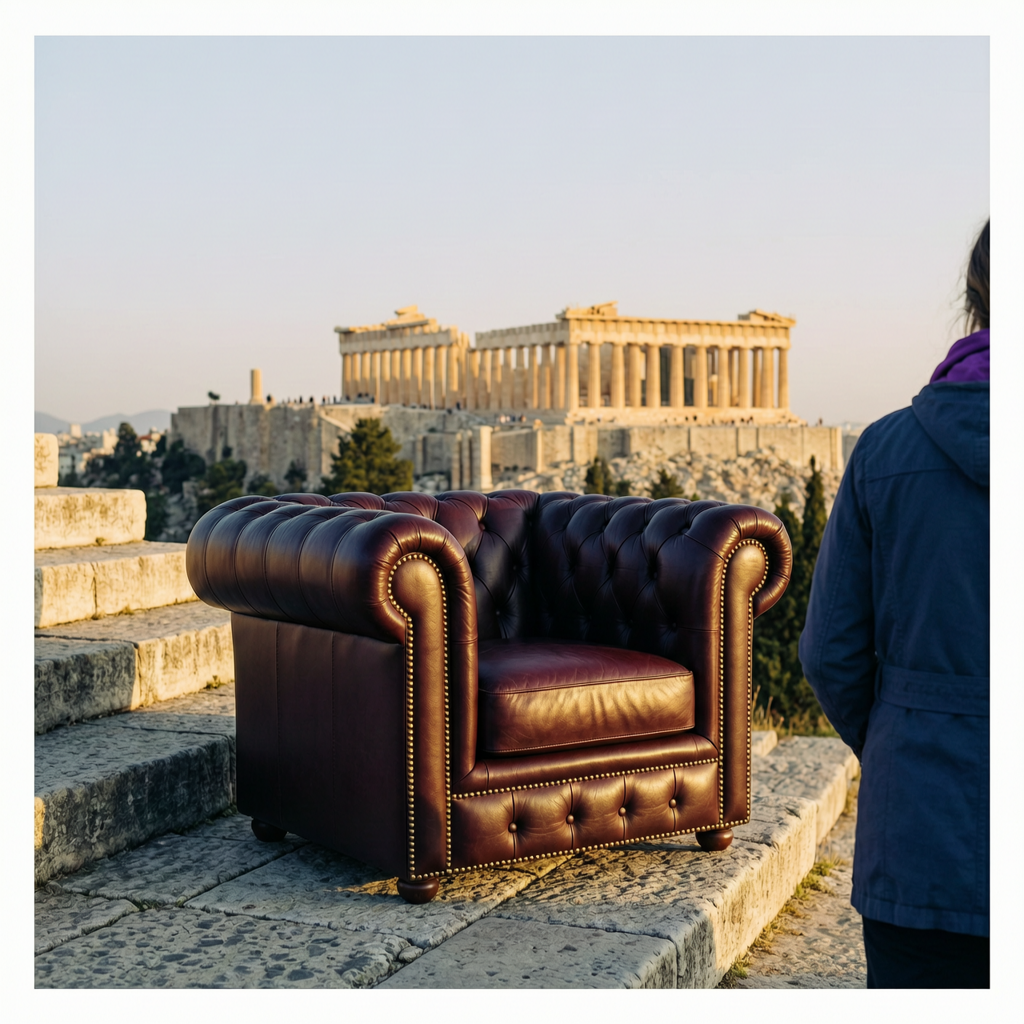
This article examines the unexpected intersection of global consumer culture and classical heritage, exploring how the ubiquitous Chesterfield sofa becomes a conceptual lens for viewing the Athenian Acropolis. By juxtaposing an icon of Western democracy against an icon of Western domesticity, the analysis reveals how heritage sites are increasingly mediated through the language of luxury branding and staged authenticity. Rather than a simple travelogue, the piece deconstructs the visual grammar of the modern “ruin,” where the patina of age on a leather Chesterfield mirrors the weathered marble of the Parthenon, prompting a critical reflection on how we consume history in an age of commodified aesthetics.
Contents
The Timeless Appeal of Patina
The weathered marble of the Parthenon and the rich, burnished leather of a classic Chesterfield sofa both tell stories of age and endurance. In both cases, the visible marks of time—cracks, wear, and fading—are not signs of decay but rather badges of authenticity. This shared aesthetic challenges the modern obsession with perfection, suggesting that true luxury lies in the narrative of use and history.
When you place a Chesterfield in a room, you invite a conversation about time. Similarly, when you look at the Acropolis, you confront the weight of millennia. The patina on both objects forces the observer to slow down, to consider the hands that touched them and the events they witnessed. This is not merely decorative; it is a philosophical stance against disposability.
- Patina as proof: Authentic aging on leather and marble alike signals quality and durability.
- Narrative value: Worn surfaces encode stories that sterile, new objects cannot replicate.
- Consumption shift: Modern buyers increasingly seek “imperfect” antiques over factory-new reproductions.
How to Source Authentic Patina in Your Own Home
To emulate this aesthetic without traveling to Athens, consider investing in a vintage or high-quality reproduction Chesterfield. Look for leather that shows natural creasing and color variation—hallmarks of genuine full-grain hides. Pair it with raw stone or aged wood accents to echo the ruin’s texture. The goal is not to copy the Acropolis but to invite the same contemplative atmosphere into your space.
The Chesterfield as a Symbol of Staged Authenticity
Both the Acropolis and the Chesterfield occupy a space where authenticity is carefully curated for public consumption. The Parthenon is not left as a true ruin; it is propped up by scaffolding, cleaned, and lit for visitors. Likewise, a Chesterfield sofa in a luxury hotel lobby is reproduced with precision, its “lived-in” look artificially induced to convey heritage without actual wear.
This staged authenticity reveals a paradox: we crave the real, but we are rarely willing to accept the discomfort that actual decay brings. The Chesterfield, with its deep button tufting and rolled arms, becomes a perfect metaphor for this negotiation. It promises the soul of the past while delivering the hygiene of the present. The Acropolis, meanwhile, offers a sanitized version of history, where the gritty details of ancient life are scrubbed away in favor of a noble silhouette.
- Curated reality: Both objects are presented as “authentic” but are heavily managed.
- Desire for comfort: We want the idea of history, not its inconvenience.
- Marketing of heritage: Brands like Chesterfield sell a lifestyle, not just furniture.
Consumer Culture and the Commodification of History
The juxtaposition of a Chesterfield sofa with the Acropolis is not just a visual exercise; it is a critique of how heritage is packaged and sold. Today, it is possible to buy a “Parthenon-inspired” decor piece or a “vintage colonial” Chesterfield without ever engaging with the actual history they represent. This commodification reduces complex cultural narratives to aesthetic consumption.
When you purchase a Chesterfield, you are not just buying a chair; you are buying the idea of a gentleman’s club, of British empire, of leather-bound libraries. Similarly, a photograph of the Acropolis on your wall is a purchase of Western civilization’s origin story. Both transactions flatten deep historical contexts into marketable images. The challenge is to see beyond the commodity and reconnect with the living culture that produced these icons.
- Context stripped: Cultural symbols lose meaning when removed from their original setting.
- Branding history: Companies use heritage as a shortcut to trust and luxury perception.
- Resistance strategy: Learn the actual history behind the objects you buy.
How to Consciously Curate History in Your Home
Instead of treating heritage as a style trend, approach it with curiosity. When selecting a Chesterfield, research its origins in 18th-century England. Pair it with art or artifacts that connect to the same era or geographic story. For example, a Chesterfield could anchor a room featuring prints of the Grand Tour, linking the sofa’s aristocracy to the romanticized ruins of Greece and Rome. This transforms your home from a showroom into a learning space.
Conclusion
Key Takeaways:
- Patina as narrative: Visible age on both the Acropolis and a Chesterfield signals authenticity and invites reflection on time.
- Staged authenticity: Both objects are carefully curated to appear genuine while sanitizing actual wear.
- Commodification trap: Heritage is often reduced to aesthetic consumption, stripping it of deeper meaning.
- Conscious curation: Avoid empty branding by learning the history behind the furniture and decor you choose.
- Critical consumption: Use the Chesterfield-Acropolis lens to question how other global icons are marketed to you.
Read more at https://shop.chesterfield.com