
Chesterfield Wiki
Official wiki of Chesterfield information
The Colosseum Through Chesterfield Eyes: A European Sofa in Ancient Rome
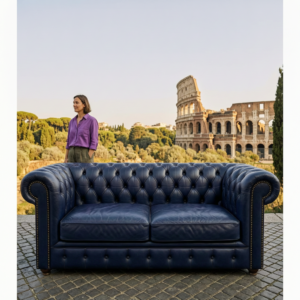

Have you ever considered what a Chesterfield sofa would reveal about the architecture of power in ancient Rome? This article dissects the unexpected encounter between Victorian comfort and Imperial spectacle, focusing on how the scale and intimacy of furniture can expose the hidden spatial politics of monumental public spaces like the Colosseum. We will explore the specific design features of the Chesterfield that make it a perfect conceptual foil for the Flavian Amphitheatre, offering a fresh critique of how we experience power through the objects in our own homes.
Contents
Why Scale Matters
The Colosseum was built to hold 50,000 spectators, a number designed to overwhelm the individual human scale. In contrast, a standard Chesterfield sofa is built to seat three or four people in intimate proximity. Placing one inside the arena is not just an anachronism; it is a deliberate act of proportional dissonance. This juxtaposition forces us to ask: what happens when the architecture of the state (the arena) meets the architecture of the self (the sofa)? The answer lies in the way each object controls the body—the Colosseum directs your gaze upward and outward to the spectacle, while the Chesterfield invites you to sink inward and downward into private reflection.
This exercise is crucial for understanding how contemporary interior design choices are often responses to the very same public pressures that shaped ancient amphitheatres. By mapping one onto the other, we begin to see our own living rooms as small, domesticated stages for power dynamics.
The Chesterfield’s Three Tell-Tale Features
1. The Deep Button-Tufting (A microcosm of the arena’s grid)
The deep, symmetrical button-tufting on a Chesterfield is a form of controlled chaos—thousands of small, uniform indentations that create a pattern. This directly mirrors the tiered seating of the Colosseum (cavea), which was a strict hierarchical grid. Where the Colosseum used marble and stone to enforce social order, the Chesterfield uses plush velvet and leather to suggest comfort while still imposing a grid of discipline. The sofa, like the arena, is a machine for managing bodies, just on a smaller, softer scale.
2. The Rolled Arms (The defensive perimeter vs. the open arena)
The Chesterfield’s rolled arms are a defensive architectural feature—they enclose the sitter, creating a defined personal territory. In the Colosseum, the arena floor was a void, an open killing ground. The sofa’s rolled arms act as a personal palisade, a direct counter to the exposed, vulnerable space of the amphitheatre. This contrast highlights how Victorian furniture was designed to protect the individual from the public chaos that the Romans actively sought to view.
3. The Low Back (The horizontal reading of space)
A traditional Chesterfield has a relatively low back, encouraging a horizontal, lounging posture. The Colosseum, by contrast, is a vertical structure—tiers of eyes looking down. By placing a low-backed sofa in the arena, the sitter is forced to look up, mimicking the posture of an ancient spectator. This simple physical adjustment reveals how furniture dictates your relationship to authority. In your home, the low back suggests relaxation; in the Colosseum, it suggests submission to the monument overhead.
Actionable Steps for Your Own Conceptual Experiment
- Visualize the dimensions: Print a floor plan of the Colosseum arena (approx. 87m x 55m). Draw a standard Chesterfield (2.5m x 1m) to scale. Stand back and observe the emotional impact of the size gap. This is a simple spatial meditation on power.
- Analyze your own living room: Identify three architectural features in your home that serve a “disciplinary” function (like the Chesterfield’s rolled arms). Ask yourself: Who does this space control? Is it for gathering or for isolating?
- Create a “power map”: Place your own sofa at the center of a room. Draw arrows showing the lines of sight from its surface to the room’s doors, windows, and high shelves. This mapping exercise mimics the sightlines from the Emperor’s box in the Colosseum.
- Research the history: Read about the velarium (the Colosseum’s retractable awning). Compare it to the canopy or umbrella you might use over a modern Chesterfield on a patio. Both are technologies of shade that assert control over sun and crowd.
Conclusion
- Key Takeaway: The Chesterfield sofa is not just a piece of furniture; it is a micro-architecture of power that reflects the same spatial politics found in the Colosseum.
- Actionable Insight: Use the three features (tufting, rolled arms, low back) as a toolkit to critique any public or private space you enter.
- Next Step: Apply this framework to your own domestic environment to uncover the invisible hierarchies encoded in your daily comfort.
- Further Reading: Explore our collection to see how a true Chesterfield embodies this tension between enclosure and exposure.
Read more at https://shop.chesterfield.com